The eighth of the twelve houses in Jyotish. Randhra means an aperture, a hidden opening, a vulnerability; bhava means house or state of being. It is also called Mrityu Bhava — the house of death and longevity. It governs transformation, the hidden, what you inherit, the occult, and sudden change — the things that arrive without your asking and remake you. The doorway to depth.
Let me say it plainly at the start: this is the house I come most alive in. When I recorded the sixth house — service, illness, the daily grind — my breath was heavy the whole way through. The seventh, partnership, was easier. But the eighth, this one, I do not have to think twice about. Transformation, the hidden, the occult, sudden change — when I put the pieces of my life beside these words, everything clicks into place, and I am awake in a way the other houses do not quite reach.
The Interview Notes
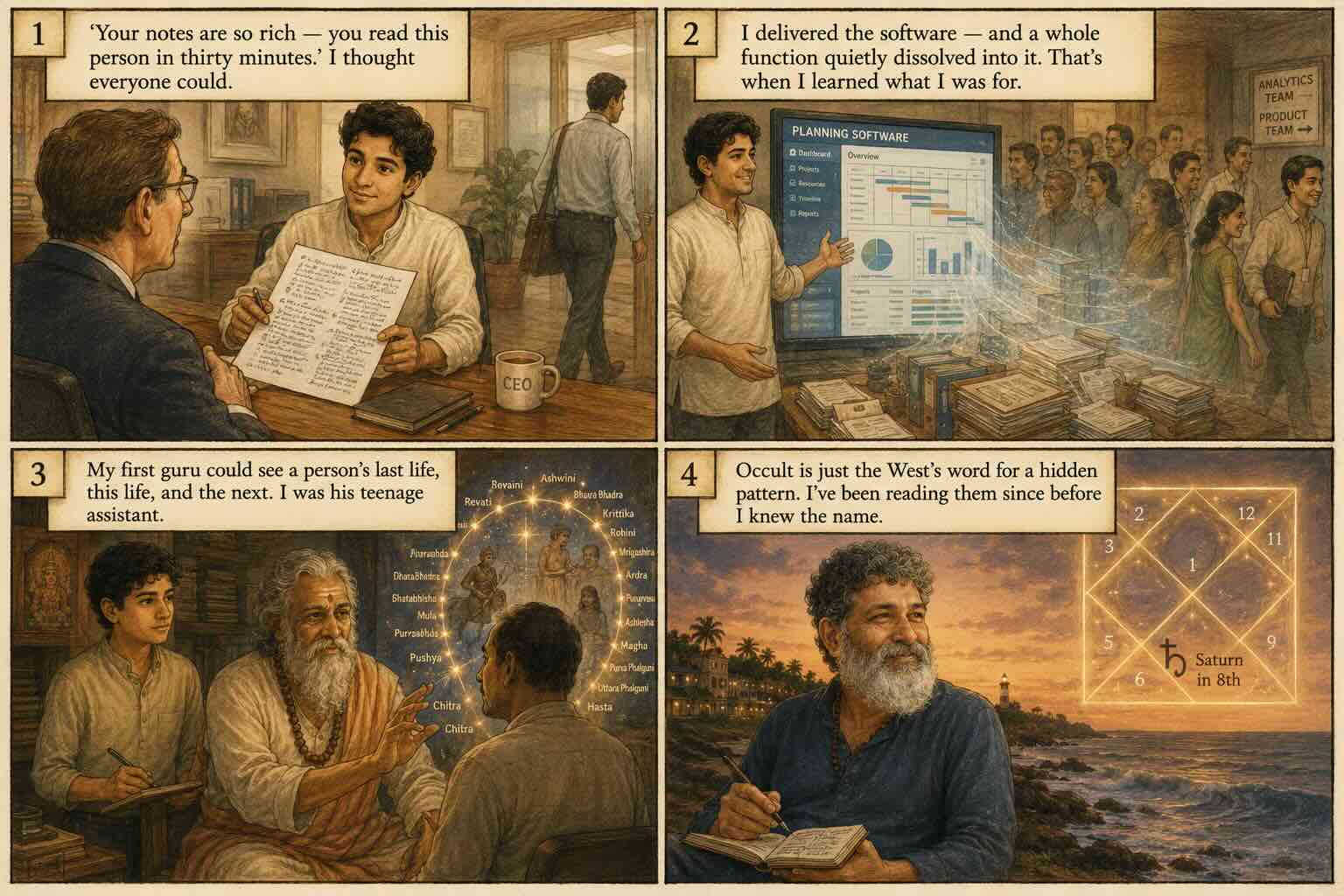
The first time I got real access to my own depth was through someone else's surprise. A CEO colleague asked me to interview a marketeer. I came back with my notes — this is what I see in the person, this is what I don't see, here is where they are in their journey. He read them and turned to me and said: your interview notes are extraordinarily rich. You've grasped so much about this person in thirty minutes.
I was young, and naive enough to assume everyone could do this — that reading a person quickly and completely was just a thing humans did. It took me years to understand it was not ordinary at all. That moment was the first crack of light into a room I did not yet know I had: the ability to sense, fast and deep, who is actually sitting in front of me.
The Team That Vanished
I spent the first part of my working life at a fairly boring desk job. Then I began to reposition myself as someone who could advise, coach, train a company. My first real project was delivering a planning software — and when it went live, it effectively wiped out an entire function. A team of around twenty-five people. Nobody lost their job; they were good people and we absorbed them into other teams. But the function itself, as it had existed, was simply gone. I had transformed it.
From then on, transformation became the thing I was actually for. Not maintenance, not running a function as it was, but standing in front of a business and asking: how could this fundamentally operate differently? Much later I realised this is exactly what the big firms — the McKinseys of the world — get paid enormous sums to do: reimagine the work, redefine the work. And the people who began gathering around me all carried the same charge. Someone who could rethink the product. Someone who could rethink the process. We recognised each other.
The Occultist I Assisted
My first guru was an occultist. He could look at a person, top to bottom, and see their last life, this life, and the life to come. The twenty-seven nakshatras of Jyotish were, for him, simply visible in the body in front of him. There were strict laws on the gift: he could only speak of what he saw if the person asked; he was never permitted to take money for it; and if anyone called him, at any hour, he was bound to drop everything and go to help them.
It made him a difficult man to be married to. His family never quite understood what he was doing — he made no money from it, he disappeared when strangers called — and yet people were transformed simply by being in his presence. I was his personal assistant through my teenage years. None of it made sense to me then. I told myself it was coincidence that this master happened to spend so much of his time with us. It has taken decades, and this house, for me to stop calling it coincidence.
A Lineage of Transformers
When I look back now, the pattern is almost embarrassingly clear. My second master, too, was about transforming people — teaching millions across the world how to breathe, how to think about life differently. And my current master belongs to a Tantra school. People hear Tantra and think of sex; this school has nothing to do with that. Tantra simply means a technique to handle your mind. It is very old — more than two thousand years — and once again, by what I used to call random coincidence, I found that my master, my wife, and my children are all connected to this same lineage.
It is a different kind of school from the others I have known. In most traditions you call the teacher guru. In ours, he is a Peethadheeshwar, and there is a specific name you are permitted to address him by. A subtle thing, but it marks how distinct this path feels from every other spiritual experience I have had. Three masters, one thread: each of them, in his own register, a transformer of people.
Sensing Energy
In the seventh house I wrote about my ability to vibe with people. Sitting here in the eighth, I understand where that ability actually comes from: I sense people deeply. I read the energy a person is giving off, often before they have said much at all. About ten years ago I was interviewing a candidate for a critical role, and I sensed that their energy was wrong for it — too charged, too driven in a particular way, when the role needed someone with a neutral, settled energy. I rejected them on that basis.
I could not write the real reason in my notes, of course — it would have read as judgmental, as bias, and there was no clean professional language for I felt the energy was wrong. So I kept it to myself, and for a long time I did not know how to tell anyone that this was how I actually worked. As I get older, I am less apologetic about it. This sensing is real, and it has rarely been wrong.
What Occult Actually Means
I want to be careful with the word occult, because it carries baggage. It came from the West as a label for anything that was not science — and then picked up a darker connotation, all black magic and cults, things people are taught to fear. That is a different conversation. To me, occult means something far simpler and cleaner: the ability to see a hidden pattern. That is all. Reading what is there but not on the surface.
I sometimes wonder what I would have become if I had recognised this as a child. Maybe I would have trained to be a detective, or gone into intelligence — some work whose whole purpose is to uncover what is concealed. There is a real desire in me now to unveil the unseen: in myself, and in the people around me. I have started doing a little coaching, and it is the same muscle — sensing a person deeply enough to actually serve what they need, rather than what they say.
Astrology as Ground
None of this would be usable without a framework, and astrology is what gave me one. Without Jyotish, all this sensing would have been a wild beast — I would have known a person's signs and patterns without any idea what to do with the knowing. Jyotish gave me a way to ground myself in it, to hold the perceptions instead of being thrown by them. There is a fitting clue in my own chart, too: Saturn sits in my eighth house — the slow planet of depth and patience, parked in the house of the hidden. Another wink from astrology that I belong here.
And the move to a quieter, coastal landscape has been part of the same work. A less intense town lets me process thoughts slowly, connect with myself more deeply, find the time to reflect and write down the experiences as they pass through — and then sit with how to make sense of them. From an early entry into astrology, to discovering these masters, to Tantra, to now going deep into Jyotish — it all coheres. This is the house where I feel at home, where I can see things through. Like every chapter I have written, it is a work in progress. But of all of them, this is the one that needed no warming up.
Occult is just the West's word for a hidden pattern. I have been reading them since before I knew they had a name.