The sixth of the twelve houses in Jyotish. Ari means enemy; bhava means house or state of being. It is also called Roga Bhava (the house of disease) and Runa Bhava (the house of debt). It governs daily work, service, health, the obstacles you walk through, and the enemies you must overcome — including, the texts hint, the ones who live inside you. It carries prarabdha too: the portion of karma that has ripened and must now be lived.
After a long pause, I am restarting the Bhava series — and this time, the sixth house, Ari Bhava. Let me be honest at the door: this was a real struggle to pin down. I did not even understand what the sixth house meant when I began. I am still learning it. It is, by some distance, the hardest house I have tried to write — which is itself the clue. If the sixth house is the house of the enemy, then my reluctance to sit with my own challenges is exactly the kind of thing it wants me to look at. So this is part one. I will add to it as I understand the house better.
The Broken Leg, and the Boy Who Learned to Sit Still
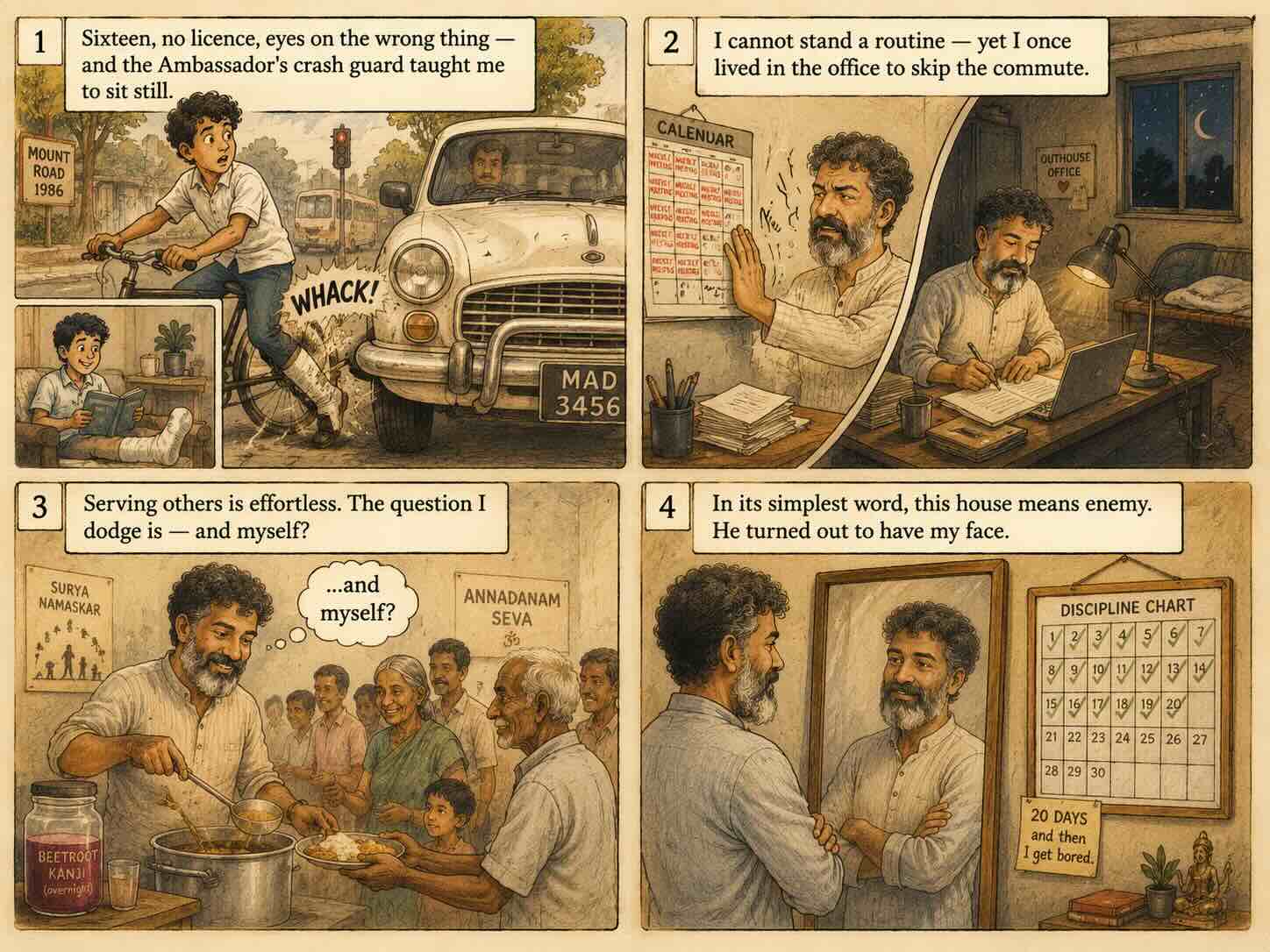
One incident comes back to me very clearly — my first accident. I was maybe sixteen, riding back from school. I had no driving licence. My friend was on the back, and like any teenage boy, I was easily pulled by the world: he said, look at those girls, and I turned. In that same moment the car ahead — an Ambassador, with one of those heavy steel crash guards bolted to the back, the kind people fitted because Ambassadors got hit so often — stopped at a signal. I went into it and broke my right leg.
I remember it so well because of what came after, not the crash itself. I could not walk. My father took me to the hospital, and then I had to sit at home for the next two months. It was the time of my board exams. And I was a boy who had always struggled with studies — I could never sit, never focus. Now there was nothing else to do. So I would get up, get ready in the morning, and sit on the sofa and study. That was the first time in my life I recognised that I could study. The accident — the obstacle, the small bodily debt the sixth house deals in — is the thing that handed me my own attention.
I Cannot Stand a Routine
Here is something I have to confess plainly: I hate daily routine. Any form of it. I resist it almost at the level of reflex. Recurring meetings, weekly check-ins, the same thing on the same day at the same time — I am in a corporate job full of exactly this, and my instinct is never to attend the recurring meeting. It is always: how do I delegate this? Not out of arrogance, I think, but because repetition itself wears on me in a way I have never fully understood.
The sixth house is, traditionally, the house of daily work — the discipline of getting up and doing the same thing again. Which means it has handed me the precise material I am least equipped for. I need a little variety to function. I cannot sit in the same place every day, cannot stand in the same spot, cannot keep my table arranged the same way. I move things, change a few things, just to make the day feel a degree fresher. Without that small rearrangement, something in me refuses.
Flat, Not Top-Down
I have written in earlier houses about my relationship with authority. The sixth house turns the lens toward the workplace itself — the daily ground of service — and there I find a clear preference. Picture the two kinds of organisation. One is hierarchical and top-down: someone sits at the top, decides, and everyone aligns. The other is decentralised, distributed, with no single centre. Today I am part of a top-down organisation. I also sit on the board of another that practises holacracy, where leadership is shared rather than held.
I am drawn, almost helplessly, to the second kind. To any organisation willing to experiment with a flatter shape. Personally, I like to treat the people around me as adults — my whole way of managing is, in a sense, not to manage them. For years I told myself this was laziness: that I simply could not be bothered to manage others. But that is not it. I find more joy, more liberation, more genuine empowerment when the structure is flat. I am not avoiding the work of leadership. I am choosing a kind of service that does not require me to stand over anyone.
The Hermit in the Outhouse
And yet — and this is the contradiction the sixth house keeps making me hold — I love to work. I said I hate routine, and I do. But if I look honestly at how I worked in my early career, I spent enormous amounts of time in the office. Even during COVID, I do not think I really worked from home; I always found a way to be next to the office. In those first four or five years I had a room to myself — an outhouse beside the office — and I more or less lived in it, just to save the commute.
I do not even know if I had a social life in that stretch. I worked twelve, eighteen hours. I went months, sometimes, without really meeting anyone. I lived like a hermit who happened to have a desk. Whether I was focused, whether I delivered the results I should have — that is a different question, and an honest essay leaves it open. But the hours were real. The long, plain, unglamorous hours were real. Some part of me will simply pour itself into work, given the chance — call it love, call it obsession, I am still not sure which.
A Healthy Body, A Healthy Mind
Health lives in this house too, and here I am quietly fortunate. Touch wood — I have never had an extended sickness. I sleep well and can fall asleep quickly. I like a good meal and a good walk. By and large my body and my mind have stayed steady, and that steadiness is the engine that has kept my life moving.
There is one recurring event, though — an annual shutdown. Once a year my body takes two or three days of cold or fever, and seems to use them to reset itself completely, the way a machine reboots. It arrives like clockwork and then it is gone. The bigger health risk for me is not illness; it is obsession. Early on I would work twelve to eighteen hours with no life around it. As recently as three months ago I fell so deeply into AI that I lost whole weeks of hours to it. What saves me, eventually, is the wisdom that comes up from somewhere and says: step back. Rethink this. The body is not the enemy here. The enemy is the part of me that does not know when to stop.
I Have Always Given
The sixth house also governs debt, and on that ledger I come out strangely one-sided. I have never really taken a loan. The only money I ever borrowed from anyone was from my father, to buy my first house. My default posture is to give, not to take. Whether it is money, friendship, time, or simply helping someone — I have nearly always given more than I have held back. In the astrological sense I am in touch with the other half of this: do I even have the skill to receive? I am not sure I do. That may be its own kind of debt — the unpaid one I owe myself.
Because alongside the giving runs a deep streak of seva, of servitude. I have genuinely enjoyed it — preparing Annadanam, serving in the ashram, helping someone senior, helping anyone at all. It comes to me without effort. The harder question, always, is the one turned inward: am I helping myself enough? It is easy for me to serve others. It is the service to myself — the rest, the routine, the keeping-in-touch — that I neglect. I do not stay in touch with family or friends, not out of any intention, but because it is a skill I genuinely do not have. I am actively trying to learn it now. It is one of the real challenges I am still working out how to hold.
Beetroot Kanji, and the Hernia I Reversed
For a while I did have trouble with digestion. Then, thanks to some friends who taught me, I learned to make beetroot kanji and overnight-soaked food — small, patient practices that quietly set it right. That is the shape of how I meet a bodily problem: not with a quick fix, but by learning my way out of it. When a hernia scare came, my instinct was not to rush to surgery. I went looking — for alternatives, for doctors' opinions, for techniques that actually worked. The hernia, I was able to reverse through a combination of homeopathy and yoga asana. The body, given the right attention, can often undo what it has done.
I do feel, underneath all of this, like a fighter. Faced with an adversary — an illness, an obstacle, a challenge life or a person has thrown at me — something in me believes it can get the better of it, and usually does. That is the gift of this house when it runs well: the conviction that the obstacle is beatable. The trouble is what happens when the obstacle is not in front of me.
The Enemy Within
Because here is the thing I keep circling back to. In its simplest word, the sixth house means enemy. And when I look honestly, the enemy is not out there. The enemy is within me — my own inability to overcome my own challenges. I know I need to work hard. I know the body needs routines to sustain it, and so does the mind. And I will simply not put in the effort. Or I will put it in for twenty days, and then I will get bored, and stop. That is the adversary the sixth house keeps pointing me toward, and he is very hard to beat because he is me.
I see it most clearly in how I learn. I am drawn, deeply, into astrology — over the last forty-something years, the only videos I will pause, watch for an hour or two, take notes on, reflect, introspect, return to, are about astrology. Anything else, I skim. I tell myself I know it almost the moment I start listening, and in believing that, I never actually learn it. Finance, work topics — I will do whatever is needed, but to push my brain above and beyond on them is nearly impossible. For a long time I thought I simply could not listen. That is not true. The subjects close to me, I can listen to endlessly. It is the rest I refuse — and the refusal is the enemy.
This house, Ari Bhava, is not natural for me to talk about — which means, of course, that I am not eager to talk about the challenges I carry with myself. So I will leave it honestly unfinished. This is part one of my conversation with disease, debt, service, and the enemy within. I am fairly sure I will spend more time here, and understand the house a little better, as it slowly lets me in.
If the sixth house has an enemy, I have met him. He has my face, and he is very patient.