The seventh of the twelve houses in Jyotish. Yuvati means a young woman, a consort; bhava means house or state of being. It is also called Kalatra Bhava — the house of the spouse. It sits directly opposite the first house, the self, which is why it is called the descendant: the other across the table. It governs marriage, partnership, business counterparts, trade, and the long contracts a life is built on. The house of the one who is not you.
Here is what I am sitting with: the seventh house is the house of the other across the table — partner, spouse, business counterpart, marriage, trade. Underneath all of those, one question. What is my relationship with long-term commitment? It has taken me most of my life, and the writing of this essay, to answer it honestly. And the honest answer is a contradiction: I am afraid of commitment, and I keep, somehow, committing for years.
I Vibe With the Other
The first thing I notice about myself in partnership is that I take my shape from the person across from me. I have an energy to vibe with the other. If the person I am with meditates, I will meditate. If they work hard, I work hard. If they study, I study. My energy aligns itself almost automatically to whoever I am hanging out with — and for a long time I did not even know I was doing it.
In earlier houses I have written about how hard it was for me to get anything done alone. The seventh house is where that turns into a strength rather than a flaw: I do not work well solo, but put me beside the right person and I become whoever the work needs me to be. The other is not just company. The other is the condition under which I function at all.
Intuition Across the Desk
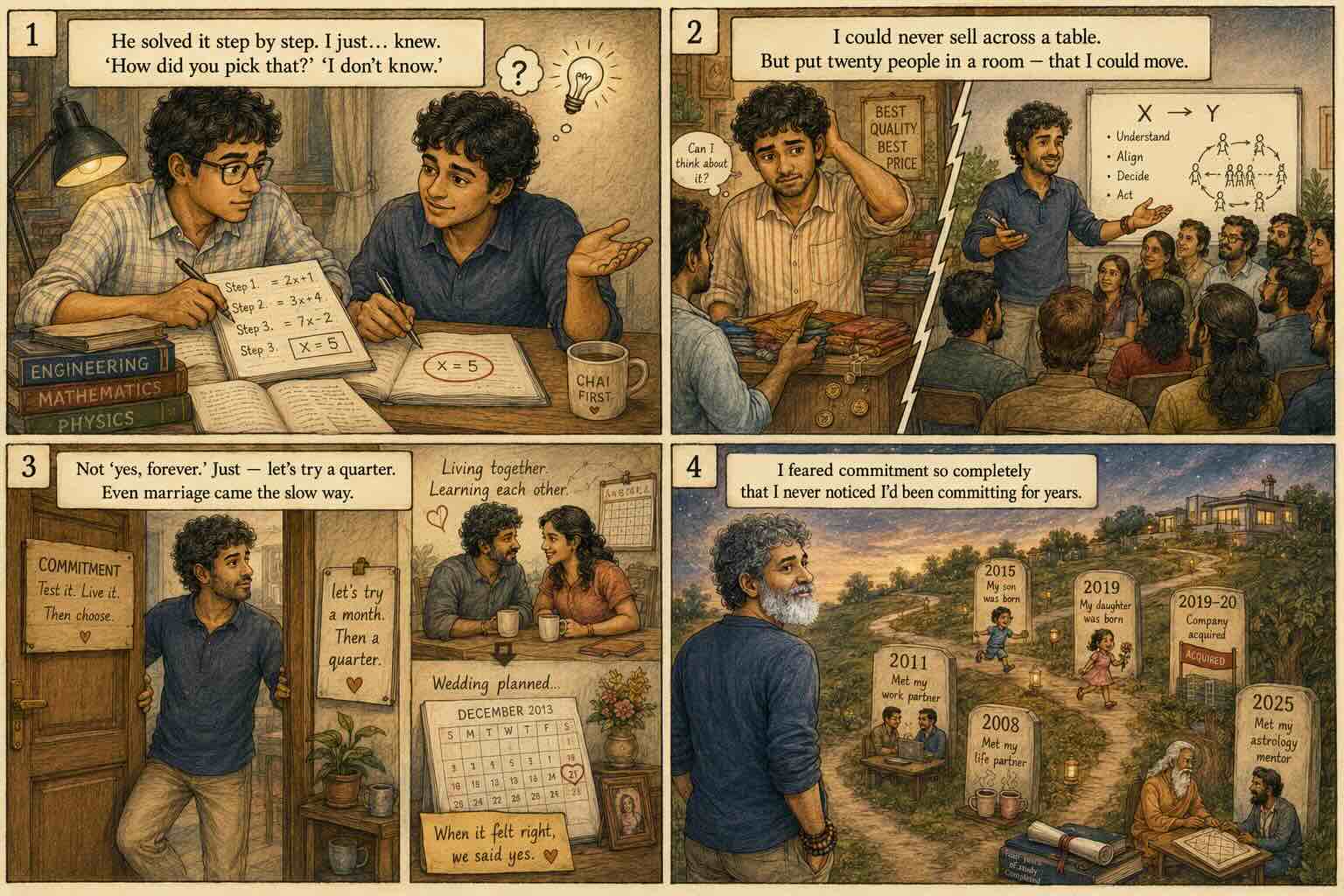
My first real partnership was a study partner in engineering. I have written before about how I could not study alone — and during those years I found my way through combined study, the two of us sitting together night after night. He was a true intellectual genius. We would work the same problem, and he would ask me how I had arrived at an answer. I would have picked it almost by instinct — read the options, felt my way to the right one. He would ask, how did you select that? And I would honestly say: I don't know. My answers came by intuition. His came by logic, one clean step after another.
He ranked around a hundred in the entrance exam. I was somewhere past two thousand — and among lakhs of students competing with the very best, even a rank in the thousands was no small thing. But at the time it confused me. What is happening? Why do I arrive at the right place by a road I cannot explain? I loved the subjects, but my route to the answer was never the logical 1-2-3. And instead of trusting that, I ignored it. I half-decided that logic was everything — a trap I still fall into some days. It took me years to understand that the intuition was not a defect in my reasoning. It was a different instrument, and the seventh house, of all places, is where I first heard it play — sitting next to someone whose mind worked nothing like mine.
Poor at Trade, Good at People
I should be plain about a limitation, because the seventh house governs trade and I am not good at it. Given a free choice, I would sit by the sea or a river and watch the water all day. A desk, a fixed seat, the same task repeated — I find it genuinely taxing. So early in my career I worked out that my ability to attract money is poor. My ability to trade is poor.
But the other half of the house is people, and there I am at home. Innovation, understanding people, thinking out of the box — blue-sky thinking, dark-sky thinking, diverging and converging, bringing twenty people into a room and walking them to a shared decision — none of that is hard for me. It is, in fact, completely natural. So is transformation as a thought: we are running business on an X model; how do we pivot to a Y model? I could always think unconstrained, the way I did as a child, with that disruptive energy of rethinking and reimagining and re-seeing. I cannot sell you a thing across a table. But I can sit at that table and help you reinvent what you are selling.
Chosen by Integrity
Because I vibe so readily with the other, I have learned to be careful about who the other is. The way I select the senior leaders and partners I work with is, before anything else, by their integrity. I am not claiming my own is unimpeachable — but precisely because I absorb the energy of the people around me, I have to make sure that energy is clean. So I choose for integrity first.
And I run a quiet process of elimination. There are industries I simply cannot resonate with — gambling, for instance; certain corners of healthcare — because I always believe there is an alternative, gentler way to do the thing. People who are only intellect, all logic and no warmth, do not work for me either. So I narrow and narrow until I find the few I can genuinely stand beside. The partner matters more than the deal, because in this house the partner becomes part of who I am.
The Fear of Commitment
Now the hard admission. For most of my life I could not commit to anyone, or anything, long term. I never signed up for long projects. Everything was: let's explore for a month. Let's try a quarter. Even with my partner, I did not begin with a marriage — we lived together for a couple of years first, and only then decided to marry. If I am honest, that is commitment phobia, plainly stated.
It shaped my whole career. A full-time role asks for commitment up front, and I could never give that, so I became an advisor, a consultant — work that let me say let me test and learn instead of yes, forever. People assumed I chose it for freedom, for the lifestyle, and that was one small part of the truth. But underneath was this: I am frightened to say yes at the beginning. Even my studies bear the mark of it — I trained as an engineer and never went deep into engineering, never committed to its depth.
And Yet, I Stayed
Here is the twist that only appeared when I sat down to write this. I look back, and my partnerships were not short at all. Enchanting Travels — where I still work — I joined as a consultant in 2011. Equal Experts, where another partnership lived, from 2018. Compasites, my first real business partner in technology, from 2013. With my own partner, the live-in became a marriage, and then a life. I feared commitment the whole way through — and I committed, again and again, for a decade at a stretch.
So the truth is stranger and kinder than the fear. I do like to commit long. I simply have to get there my own way — by testing, by learning, by earning the yes slowly instead of declaring it on day one. The template is always the same question: can I be valuable to my partner, and can I see that value returned? Where I have broken the test-and-learn pattern and leapt straight to a conclusion, it has tended to go wrong. The slowness is not the obstacle to my commitment. It turns out to be the shape of it.
Eight Lenses, Not One
I was writing about Ashta Lakshmi the other day — the eight forms of wealth — and it folded back into this house. I was talking with my son, and I said: you can look at a marriage, a partnership, a life, through a single lens of money — one person earns the wealth, the other "just" keeps the home. Or you can notice that the one keeping the home is bringing seven other kinds of wealth that go completely unnoticed if money is the only thing you are trained to count.
That is, in the end, what the seventh house has been teaching me. A partnership is not a transaction across a table, settled in a single currency. The person across from me is bringing things I cannot price — and the work of a real commitment is learning to see all eight of them, not just the one that shows up on an invoice.
What I'm Committed To Now
I once started my own company. I ran it for a while, kept it deliberately to a single-man business, never had any interest in scaling it, and eventually shut it down. I can celebrate that it existed; I also know that scaling it would have asked for a commitment I did not yet have. That was the old pattern.
The new one looks different. Late last year I joined a four-year programme in Jyotish — the first time in my life I have committed to a multi-year study of anything. Astrology came to me as a teenager, left, and has returned now to stay. And when I list my true long-term commitments, the list is real and it is long: the work I do helping companies transform through technology; my partner, and the life and the challenges we carry together; my daughters; and a commitment to make a difference to myself, my family, and the country I come from. Great things do not happen without commitment — and the man who was so sure he could not commit has, quietly, committed to all of these. I am, at last, able to write about long-term commitment from the inside of one.
I feared commitment so completely that I never noticed I had been committing for years.