The twelfth and last of the houses in Jyotish. Vyaya means expense, expenditure, loss — what flows out and away from you; bhava means house or state of being. It is also called Moksha Bhava — the house of liberation. It governs foreign lands, isolation and retreat, sleep and dream, and the dissolution of the self into something larger. The most precious expense, the texts say, is what you let go of.
This is the last matchbox, and a fitting one to end on. The twelfth house is foreign lands, isolation, dream, and moksha — release, and what you let go of. When I hold my own life against those words, one thread runs through all of it so plainly that I am almost embarrassed not to have named it sooner. The thread is foreign. Wherever there was a choice between the familiar and the foreign, I chose the foreign — and I have been quietly leaving home my whole life.
Leaving Kerala
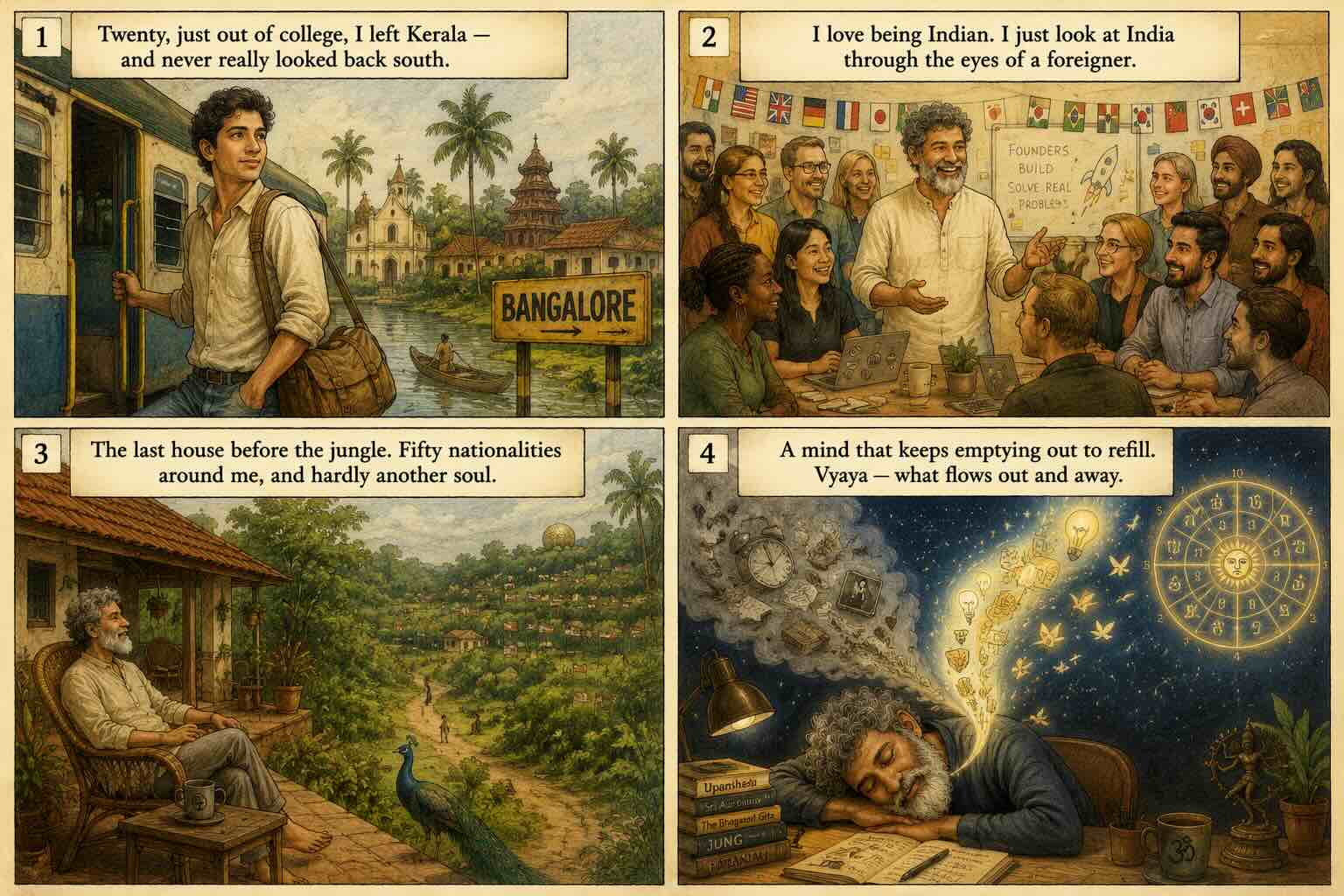
I was born in Kerala, but I left early — twenty, maybe twenty-one, right after college. My mother had only just come home, and yet I never really resonated with the South of India at all. I simply began travelling away from my hometown. Bangalore was the first discovery. In between there was Chennai. I worked with a Spanish company. Bangalore stayed the base, but I kept coming and going from it, always in motion, always partly elsewhere.
I do not say this with any disregard for where I am from. But the leaving started so young and felt so natural that it now reads, in hindsight, like the first move in a pattern I would repeat for the rest of my life. The home I was given was a place to depart from.
Always the Foreign
Given a choice, I have always chosen the foreign. And I want to be careful here, because this is not a disregard for Indianness — I love being Indian, I love everything about India. But I look at India through the eyes of a foreigner. I have always gravitated to Indian startups and Indian founders rather than Indian companies; with the latter I have genuinely struggled. One of the most joyful moments I can remember at work was simply learning that a company I was part of had more than twenty nationalities in it.
It goes back as far as I can see. I hung out with people far above my age, who felt foreign to me at the time. I sat with astrologers when I was thirteen or fourteen — foreign. The subjects that drew me, the temples, the topics, all carried that same quality of foreignness. I could never work comfortably with the homeland, with the thing I was supposed to already belong to.
A Life Among Foreigners
When I look at the people closest to me, the pattern is total. My current boss, my partners — foreign. My life partner does not come from the same culture as me. My doctor is not mainstream; I go to the alternative therapies, which look foreign to most people. My choice of spirituality is foreign to many. None of this was a plan. It is just where I keep arriving.
So there is a deep current of foreign thinking in me, and the honest definition of it is this: what I grew up with, what I was used to as a child, is not what I am comfortable in today — not in life, and not at work. The familiar is the thing I move away from. The foreign is where I exhale.
The House at the Edge of the Jungle
Look at how I live in Auroville now, and the twelfth house is almost literal. Mine is more or less the last house, right next to a jungle. There is hardly another human around. I am a foreigner to this land, with no inherited connection to it — and I am surrounded by foreigners. The place I live holds more than fifty nationalities. The company I work with is run by foreign nationals. The investors backing it are foreign nationals too. The thread of foreign in my life is not faint; it is very, very strong.
I have been reflecting on it, even gently arguing with it. Could I work with someone local? When I sit with that question, a small struggle rises, a bit of a rebel. But I am committed to learning, so I am exploring it — how to work with local leaders, with different kinds of leaders than the ones I instinctively reach for. There is even a quieter, stranger thought that drifts in: that I should earn in dollars or pounds rather than rupees. I genuinely do not know why these thoughts come to me. They just feel foreign, and the foreign has always felt like mine.
Isolation
Isolation has always been in my life, and the twelfth house names it without flinching. I like people, but I am not a social person. I have not been deeply in touch with my family. I have always kept a few friends I can return to — but if you ask me whether there is anyone truly close in the family, the honest answer is no. It is not something I nurtured or developed, and I am aware of that. The retreat is not a wound I am nursing; it is closer to the shape of how I am built.
The house at the edge of the jungle is, in that sense, exactly right. Solitude has never frightened me. I have spent a working life among foreigners and a private life at a slight remove from everyone, and I have been, on the whole, at peace there.
Sleep, and the Dreamer
The twelfth house holds sleep and dream, and I am, plainly, a dreamer. I keep dreaming up new ideas, new thoughts, new ways of doing things. It is very difficult for me to repeat the same thing twice; I would always rather come up with something new. I wake up with a fresh idea I want to execute, and then the next morning another one. The dissolution this house speaks of, for me, looks like a mind that will not stay still — that keeps emptying itself out and refilling overnight.
And maybe that is the deepest reading of the foreign in me. To always prefer the new over the familiar is, in a sense, to keep letting go — to refuse to grip what I already have so that something else can arrive. Vyaya means expense, what flows out and away. I seem to be built to spend rather than to hoard: ideas, places, belonging, all of it released so the next thing can come.
The Last Matchbox
Honestly, I reached a point where I did not quite know what else to write for this house — and that feels right for the twelfth, the house of release. It is the one that asks you to stop holding on. So I will let it be unfinished in the way the others are: a first start, a thread pulled and left hanging, rather than a conclusion tied off neatly.
But there is something else here too. This is the twelfth house, and so it is the last of the twelve. The chart is now whole — every matchbox opened, every house walked through, body to release, the self in the first all the way round to its dissolution in the twelfth. I began this series not knowing what I would find in the boxes. What I found was a life, looked at twelve different ways. The most fitting place to end is the house of letting go.
I have been quietly leaving home my whole life. It turns out the foreign was where I was always headed.