The third of the twelve houses in Jyotish. Sahaja literally means born with — the ones who arrived in the world alongside you. The house of siblings, valour, the hands and arms, short travel, hearing, and the small acts of will that quietly build a life. The journey you make without leaving your district.
If the second house is the lineage you were handed, the third is what you do with your own two hands once nobody is watching. It is the house of brothers and cousins — the ones who were given to you. It is also the house of parakrama, valour. The Sanskrit word for courage is not the cinematic version. It is the small, quiet motion of stepping towards a thing instead of away from it. The journey, the texts say, that you make without leaving your own district.
I was born into the Balakrishnan family with two older brothers, a cluster of cousins, and a set of aunts and uncles who came in and out of the house as if they all lived there. The siblings half of this house is easy to name — I have names and faces for it. The valour half is harder, because I was never a brave child in any obvious way. What I had instead, very early, was a habit of walking towards things I did not yet understand.
Two Brothers
My eldest brother is Sree Ram. He took up civil engineering — there was no computer engineering glamour yet in the late eighties; the natural top of the heap was civil. He did quite well at it. He was my early inspiration to take math and science seriously. A karma yogi by temperament. Well balanced. Steady. The kind of older brother who, just by being there, told me what a working life could look like.
My second brother is Sreedhar. Three years older than me, charismatic, expansive, ready to help anyone who came around. Mr. Popular in school, and the kind of person it is genuinely difficult to dislike. Reading him now, through the lens of astrology, makes immediate sense — Jupiter-loud, a Guru placement, generous to a fault. He found it hard to say no, and he always found a way to help. The limelight kept finding him because he was visibly worth helping.
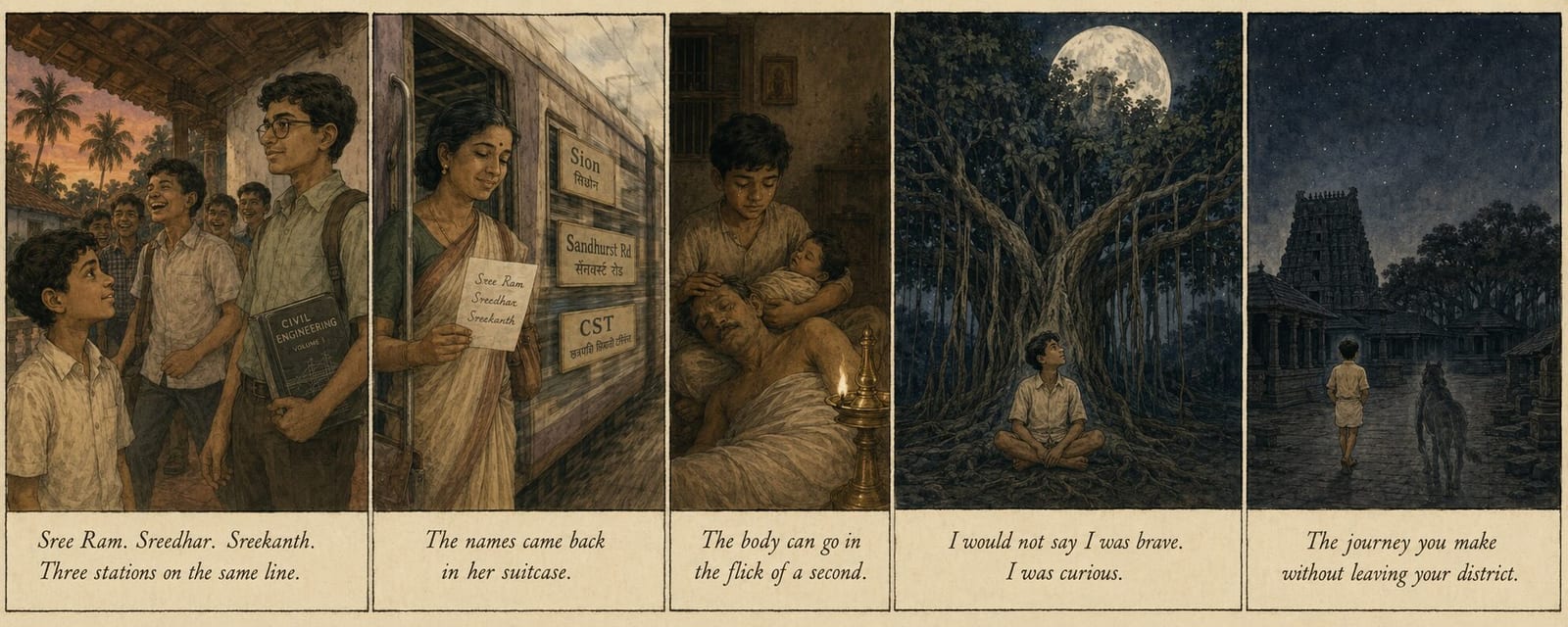
Our names, taken together — Sree Ram, Sreedhar, Sreekanth — read like a small mantra. I used to assume the prefix simply ran in the family. Years later I learned the more specific story: my dad's youngest sister, Vishalamatai, lived in Bombay. She rode local trains. She was steeped in Mumbai's everyday culture. My dad was close to her, and the names she suggested for us came back in her suitcase, carrying the rhythm of those train announcements as much as they carried any Sanskrit. Sree Ram. Sreedhar. Sreekanth. Three stations on the same line.
Cousins, Aunts, the Patola Circle
The siblings of this house were never just my two brothers. There were cousins — the family's first girl children, Sabi and Bhanu, on my dad's first brother's side. Then Vidya. We grew up either visiting their homes or having them visit ours. Holidays smudged the boundary between sibling and cousin until it stopped mattering.
Dad's eldest sister was Geeta Attai — attai is the Tamil word for father's sister — and she had two sons; one was Karthik, and the other we lost very young. Then there was Radha Attai, who had no children of her own but was unusually close to my dad. Sreedhar pretty much grew up as Radha Attai's son when we visited Coimbatore. She was hands-on, strong, and very direct. A second motherhouse without ever being announced as one. Prema Attai had two sons, Deepak and Abhishek. And then Vishalamatai, the youngest, the one from Bombay, the one whose ears the names had come through.
So when I say siblings, I mean a small republic. Brothers I was raised next to, cousins I was raised across from, aunts who folded in and out of my mother's place at the stove. The Patola group — the older family name that traces back to scribes who once wrote on silk leaves — had not narrowed yet. It still lived as a circle.
Gopu, and Nonu in My Arms
My dad's second brother was Gopu. He drank — and when I say drank, I mean the kind of drinking that takes a man away from his life in instalments. He had a son late, my cousin brother Sreenath — we called him Nonu. His name carried on the Sree-line a fourth time. I was effectively his older brother from the day he was born. I doted on him. I was also very close to Gopu.
I was somewhere around twelve, in tenth or twelfth standard, when Gopu became seriously unwell. Liver cirrhosis. He died vomiting. He died on my lap. Nonu, perhaps a year old, was in my arms. Until then I had been a protected child — death was a word, a ritual, something that happened to other people's grandmothers. That afternoon it was a body in my lap and a child in my hands. The first dead body I had ever seen was a person I loved.
Not long after, we lost my grandmother. Two deaths back to back, in close succession, in the same house. Whatever held the world up for a child of twelve quietly slipped a notch.
The understanding that arrived was not philosophical. It arrived as weight. The body can go in the flick of a second; it is not in anyone's control; and so, while we are here, the only honest response is to acknowledge that we are here. Something like that. I would not have phrased it that way at twelve. But the seed of that sentence was planted then.
The Banyan Tree, at One in the Morning
A year or two later, two small children in our area died in quick sequence. One had fallen into a canal — the water washed him away before anyone could reach him. The second died similarly. The neighbourhood was shaken. Kerala has a particular way of responding to such moments: a practice called Ashtamangala Prashna, a derivative of Prashna Shastra in Jyotish, where a question is put to the universe and the answer is read in the configuration of a chart drawn at that exact instant. The community gathered, and the chart was drawn.
Two things came back. One was that a third death was anticipated. The other — half-spoken, the kind of thing that is meant to stay inside the circle of elders but always seeps to the edges — was that something was hanging out in the banyan tree at the temple.
I was fourteen, maybe fifteen. I had just come back late from a college trip — eleven, twelve, perhaps one in the morning. I went and sat under the banyan tree. Alone.
I will not pretend that was brave. It was curiosity, dressed up in the costume of doing nothing. I wanted to know what ghost meant in our particular dialect. Could it be experienced? Would it interact? Was it real, was it mind, was it some third thing the language did not have a clean word for? I did not have a hypothesis. I had a question, and I went to the place where the question lived, and I sat there until the question got tired.
Nothing dramatic happened. The leaves moved. The temple was quiet. I walked home. But somewhere in that night, the line between fear and curiosity got thinner for me, and it has stayed thin since.
Walking the Temple After Dark
Kerala in those years had load shedding. Officially announced, often not honoured. After seven in the evening, the world simply went black for stretches at a time. After nine, the world outside our front gate was wind and stories.
The ancient Shiva temple near our house was two thousand years old and roughly fifteen acres of complex. I would walk through it alone in the dark. There was the practical fear — snakes — and there was the inherited fear: the ugra devatas the elders talked about, the fierce energies that rose at temple festivals in Kerala that you cannot quite explain to anyone who has not stood in front of one. There was the four-legged figure the locals called Odiyan — these sound like mythology when you read them in a paragraph, but the thantric layer of Kerala is alive in a way that does not always negotiate with the rational layer. I do not pretend to know what part of what I encountered was real and what part the mind generously supplied. I only know that as a child I walked through it.
The practice was simple, although I did not call it a practice at the time. Let the mind unfold whatever it wanted to unfold. Hear it out. Keep walking. The wind was always there. The temple was always there. Whatever else arrived, arrived as a guest. I did not invite it and I did not refuse it. I just held the space.
Saints, Soothsayers, Oracles
Around the same years, a woman started coming to the temple. Always in white. She had a habit of mind-reading the people standing in front of her, and then speaking, plainly, about what was about to happen to them. Sometimes it landed. Sometimes it did not. But the gap between her and the rest of the world was small enough to be unnerving.
Then there was Nair uncle, who arrived in the family through a business introduction my dad had brought back from Chennai. Nair uncle did not just read a chart. He read what felt like the twenty-seven nakshatras and the life that came after — not as prediction, exactly, but as a kind of geometry. He became a quiet, guiding presence in the house. (I wrote about him in the second-house essay; he belongs there too. The third house is where I started really hearing him.)
And then there were the oracles at the Devi temple. When you stood in front of one, something opened. A portal is the word I have for it, although the word is too clean. You did not always know what you had stepped into.
None of this is sold as truth. I am only saying that as a child I encountered, in quick succession, what most people meet much later in life — death in my hands, a banyan tree at one in the morning, a soothsayer who knew, a temple that did not care whether I believed it. Things I did not have the vocabulary for, arriving at the age when you are still building the vocabulary for ordinary things.
What Courage Actually Is
Looking back, I have not done anything spectacularly brave. I have not climbed a mountain. I have not pulled anyone from a fire. The valour the third house talks about is not that kind. It is the small, accumulated motion of stepping towards a thing instead of away from it — death, dark, dialect you don't yet have words for, an aunt's grief, a cousin's father dying on you. The journey you make without leaving your district.
What the third house gave me, I think, was an early apprenticeship in walking towards. The brothers gave me the model — Sree Ram steady, Sreedhar generous. The cousins gave me the circle. Gopu's death gave me the speed at which a life can leave a body. The banyan tree gave me curiosity in place of fear. The Shiva temple at night gave me the patience to sit with what I could not name. The oracles gave me the suspicion that the world is layered more deeply than it looks.
That is what I carry from the third house. Not a heroic story. Two brothers, a republic of cousins, a body that died on my lap, a banyan tree, and a dark temple I learned to walk through without making a fuss.
The next house — the inner room, the mother, the house behind the house — is for another essay.