The second of the twelve houses in Jyotish. Dhana means wealth or sustenance; bhava means house or state of being. It governs family of origin, voice and speech, accumulated resources — the things that nourish you from the very beginning. The lineage you were handed without asking.
I was born on December 18, 1980, close to Christmas, into the Balakrishnan family. But that is the shortened version. The fuller version begins with the name of the house I was born into: Koundanya. As in the Rishi Koundanya — the lineage we trace our name back to. And alongside that, a second thread: Patola. In Malayalam, patola carries the word for leaf — the silk leaf, the medium Rajas once used to write manuscripts, preserve royal records, issue land documents for the kingdom. What I could piece together, through conversations over the years, was that my great-grandfathers were scribes at some point. Keepers of the written word. The Patola identity stopped being carried forward in most branches. But the family group is still called Patola. And I grew up in a house called Koundanya, two hundred metres from the Thrissur railway station, in Kerala.
That sentence — the house we grew up in — does not quite capture it. It was more like a small ashram that happened to have an address.
Dad — Pichu
My father migrated young, from Tamil Nadu to Kerala. He was the eldest of four brothers and four sisters, born into a family with significant financial challenges. His pet name was Pichu — which came from the word Picchai, meaning begging. The story, as my grandmother told it, was that the first two children in the family had not survived, and after an intense period of penance and prayer, my father arrived as a gift of grace. So they named him Picchai: the one who was given, not just born.
He was a man of steel. He built a factory from the ground up. Got his sisters married. Cared for his mother. Held the family together through years I cannot fully imagine. For the longest time I thought he was simply loving and caring — which he was. It was only much later, when I had words for it, that I understood he was probably also emotionally unavailable in ways I couldn't name as a child. But I deeply loved him. We lost him in 2012.
His business was called Super Industries. His pet name around town was Super Swami. Which made me, naturally, Super Swami's Mone — Super Swami's boy.
The House
My dad had a clear theory about land: when you are young, buy somewhere still far from the city, procure it cheaper, and develop it over time. The house in Thrissur was right next to the railway station — not a well-known area when he bought it, but one that grew around us. For a long time we were one of only two families living there. He had also bought a very old bungalow in a place called Boothold, from another business family.
Our roots were Brahmin, but what we actually did was trade and business. Spirituality was never far, though — it lived in the temples, the rituals, the culture rather than in any formal declaration.
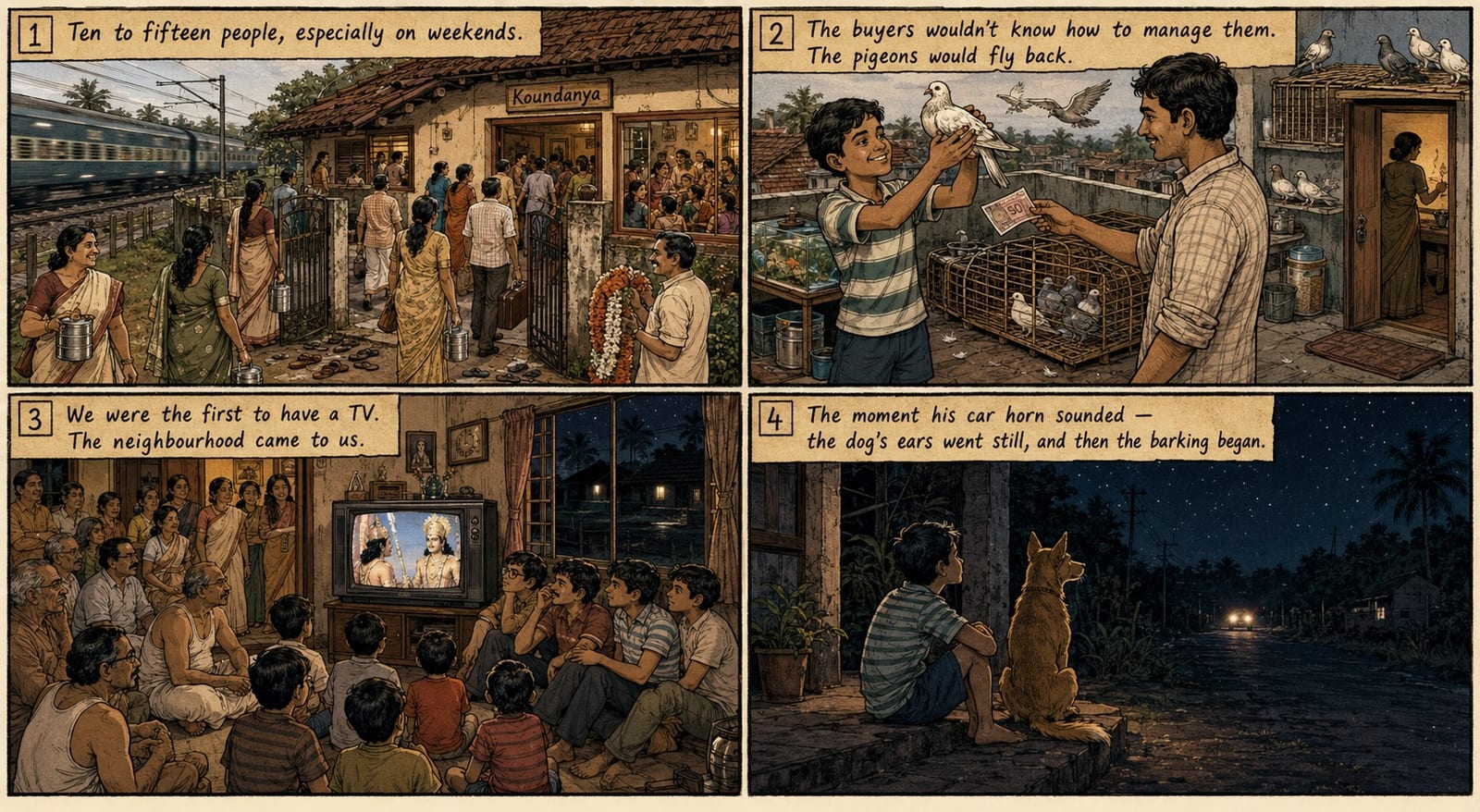
The house was almost always ten to fifteen people, especially on weekends. Dad's two brothers lived with us. His sisters stayed a few hours away and visited often. Guests would come to Thrissur to visit the Guruvayur temple — dedicated to Guru and Vayu — and our house, two hundred metres from the railway station, became their natural camp. We had a Pooja room with two large photos of Mahalaxmi and Saraswati, Ganesha at the centre, and Venkateshwara below. And we had the ancient Shiva temple nearby — two thousand years old — and a Devimata temple. These became more home to me than I realised at the time.
Three Brothers, a TV, and a Den
We were three brothers. I am the youngest. My first brother is five years older than me; my second, three years. My first brother left the family quite early — by the time I was in my teens, he was already gone. My second brother is excellent with the house: cleaning, managing, caring. He was Mr. Popular in school, resourceful to everyone around him, and the most loved by teachers.
He also had a side business: pigeons. He would catch them, raise them, sell them — for forty rupees, fifty, a hundred. Not big money, but clever money. The buyers wouldn't know how to manage them, so the pigeons would fly back. And he'd sell them again. My mother wanted no animals in the house, so we had a secret den on the terrace — varieties of fish, varieties of pigeons.
We were also one of the first families in our area to own a car, and definitely the first to have a TV. I remember the whole neighbourhood coming over to watch Mahabharata or Ramayana on cable — programming ran only from three in the afternoon to nine at night in those days. People would gather around six or seven in the evening. It was a shared experience in the truest sense: strangers and neighbours sitting together in our living room, watching the same story.
The Long Drives
Our weekends were long drives from Thrissur to Coimbatore — just across the Tamil Nadu border — in whatever car we had at the time. Ambassador Mark I through Mark IV. A Fiat. A Maruti. A Mahindra Commander Jeep. These were mostly second-hand cars that came with their own personalities and problems. My dad never bought first-hand.
The most common memory: forgetting to turn off the headlights, finding a drained battery, and waiting by the roadside. But the roads were narrow in the nineties, and if a truck got a puncture, everyone waited. We didn't mind. There was coconut water to drink, roadside food to eat, conversations to have. We three brothers would debate the top speed of the car. We also spent a lot of time at car workshops — learning how engines worked, how to fine-tune, how to fix things. The mechanical world was not separate from our world.
After Dark, and the Dog's Ears
After six in the evening in our area, the world went quiet. Kerala had load shedding — announced in the newspaper, but always its own duration. Between seven and nine, the power would go. We'd sit outside and stargaze. When it rained, the power went too. Nobody made much of it. Life kept moving.
I also remember our dog. The moment my dad's car horn sounded — one or two kilometres away — the dog's ears would go still, and then the barking would begin. Some things are that precise. A loyalty so finely tuned it could hear what the rest of us couldn't yet.
Never a Dull Day
There was never a dull day in that house. If it wasn't a business-related trip, it was a puja. If not a puja, a temple festival. If not that, a visitor — Nair uncle's guests, relatives passing through, neighbours dropping by. If not people, then projects — college work spread across the floor, or helping dad with something he was building or fixing. If nothing at all was happening, we'd just watch the fields — infinite and open.
A marriage would come around, and Kerala weddings are something else entirely: the noise, the colour, the banana leaf lunch that somehow makes everything taste better. And if even that wasn't there — we'd pluck a mango or a jackfruit from the tree, make a quick pickle, help Mom or aunty in the kitchen, wash the dog, wash the car, clean the front yard. There was always something being constructed or repaired somewhere in the house. And during the rains, we'd simply sit and watch — simbly, as any Malayalee would say it — just watch the rain fall. That was enough.
The biggest annual celebration was Thrissur Pooram — lakhs of people, elephants, percussion, a gathering unlike anything else. My dad was one of the founding members of the temple where Pooram was held. Getting close to the event when the crowd is that size means knowing the organisers. We knew them.
Nair Uncle
My dad once went to Chennai for a business deal. He came back having met a business partner who introduced the family to Nair uncle — an astrologer. Nair uncle became a quiet, guiding force for all of us. He was a unifier. I don't remember us all sitting together at a meal very often — everyone had different schedules. But when Nair uncle was home, we all gathered. We all ate together. Something about his presence made that possible. He didn't need to say much. He just arrived, and the house collected itself around him.
Being the Youngest
To be heard in a large family is its own kind of work. The share of interaction that naturally came my way was small — people came to see my dad, or his brother, or my older brothers. In front of family, I was always someone's son, someone's younger brother, someone's grandchild. Not yet myself.
Mom was always busy — cooking, hosting, keeping the house. She was mostly unavailable, not by intention, but by circumstance. Our aunts and dad's younger brother stepped in. My dad's youngest brother is the one who took care of me the longest, and I still carry a special love for him — I think of him before I think of my parents when I remember being cared for.
More than any individual, it was the collective — the ancient Shiva temple, books, the rituals, Nair uncle, the road trips, the evenings outside under no light — that held me together. That nurtured my soul.
There was Murali — classmate, engineering friend, playmate. Rupesh, Shyam, Vikas, Anoop. Some of my brothers' friends became my friends. There was a small world of people around me. But I wouldn't say I had a deep childhood friendship that I nurtured for a long time. I was craving more, and I couldn't quite name what I was asking for.
Something else I notice now, looking back: I had no girl friends until 9th grade. Not something I was conscious of then — it was just how the world was arranged. School, cricket, the workshop, the terrace den. All boys. It was only around 9th that that changed. A small but real opening.
If I had to put it in one line: detached, dispassionate, and do whatever you can best with what's available. That is how I remember family time. Not with bitterness — with a kind of clear-eyed acceptance that only makes sense in retrospect.
The story of my voice — where it went, how it found itself — that is for another house.