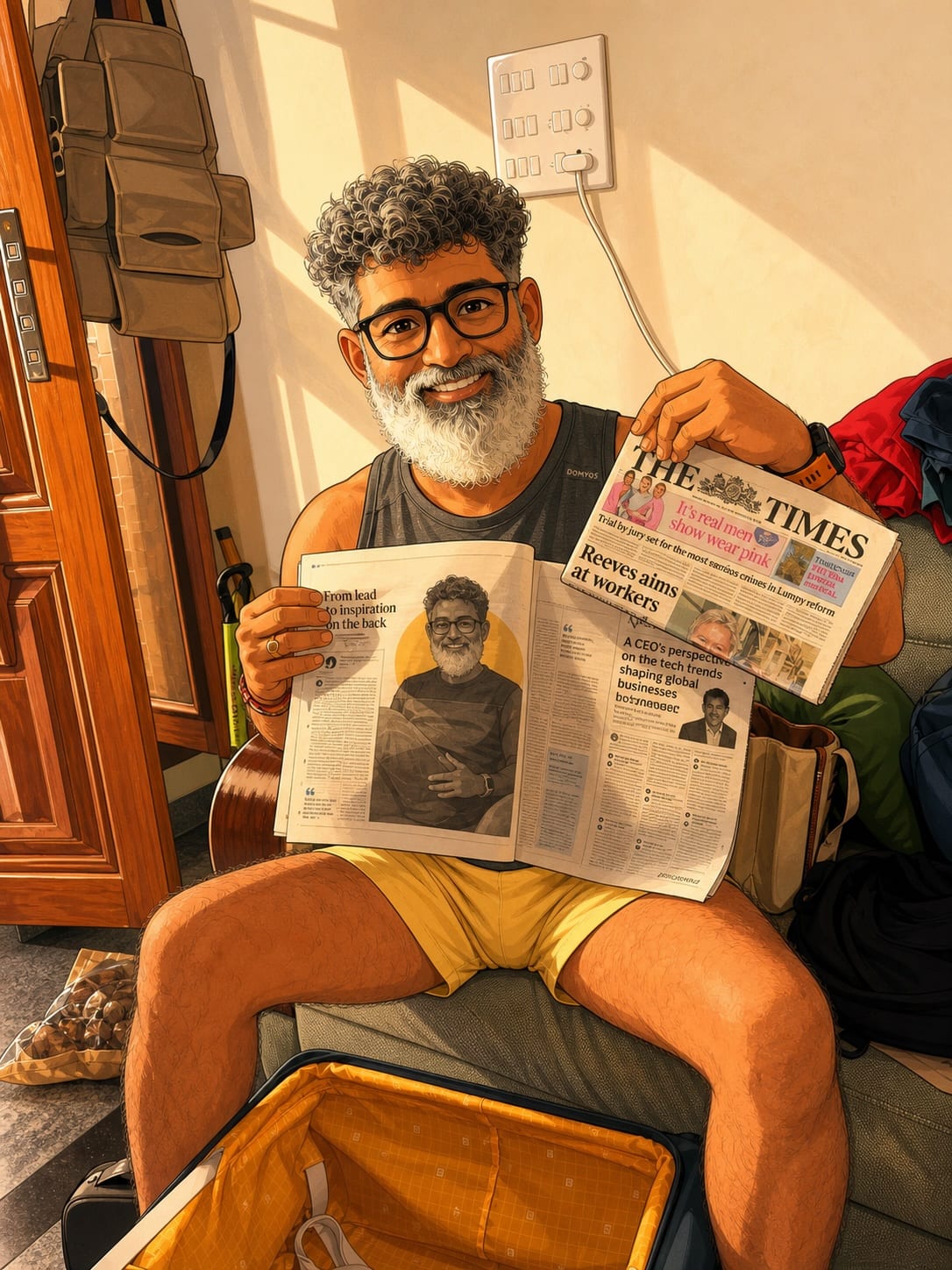
It started with an email from Sally Whittle. She wanted to talk about Travelopia's AI work. Sally writes for Raconteur — a UK publisher whose special-interest business reports are distributed inside The Times and The Sunday Times. I said yes the way you say yes to most journalist emails: one part of me thinking "this could be useful for the company," another part thinking "she probably won't write it."
She wrote it.
Two years before the call
The piece opens with this line: "Two years ago, Sreekandh Balakrishnan was at an all-time professional low." That is true. Forty-five years old. Technology director at a global travel group. Two decades of building software. And I was looking at a wave that seemed to make the craft itself obsolete.
The fear was specific. It wasn't that I would lose my job tomorrow. It was that I would, two years from then, become the leader who could not answer the CFO's question.
Two developers, three months
What we did is now public — the Raconteur piece carries the full account — and Sally got it right. Two developers carved out for three months. Six initiatives running in parallel against the traditional teams. The two-weeks-versus-one-hour moment. Twenty-five squads now. A six-figure annual investment in tools and licences — modest at the company level, meaningful for any one team. A complex module that used to take six weeks done in three days.
The article gets all of that right. There are things 1,200 words of newsprint couldn't hold.
The heart-to-hearts
Sally mentions this in one sentence. "He spent four weeks having heart-to-heart conversations with employees." That sentence carries a quarter of the year.
What I learned in those four weeks: people don't fear AI. They fear being made small. They fear having spent two decades getting good at something only to have the something stop mattering. Listening to that, person by person, was the actual work.
Some chose to leave. Most chose to stay and learn. The ones who left were not failures of the program — they were honest decisions, and I respect them for it.
What Sally couldn't print
There are details that didn't fit in 1,200 words. Not because Sally missed them — she's sharp. Because newsprint is finite.
The first six weeks were a mess. Inconsistent prompts. Confused outputs. Two developers wondering if they had been demoted. I spent weekends learning the tools alongside them. Not as a leader watching from a distance — as a beginner sitting beside two other beginners.
The buy-don't-build instinct that Parik and Alex had drilled into me a decade earlier — that's a different matchbox, story 02 — became the deciding instinct again. AI is not a tool you buy; it is a process you learn. But you still have to decide when to bet on it.
The two developers — I won't name them, because the work was theirs, not the name's — went on to become the change agents of the wider team. They taught the others. They taught me. If you read the piece and wondered who made it possible, it was them.
Forty-five, and reading about myself
The article went live on the 2nd of January 2026. I read it on my phone, on the way back from a family trip. Sripriya was beside me. My mother had just woken up and asked what I was reading.
The opening line — "at an all-time professional low" — is jarring to read about yourself in a UK publication. I knew it was true. Seeing it in print made it true in a different way.
To start telling the story Sally told — the hero arc, the lightbulb moment, the team transformed. The actual story is messier. The work isn't done.
What I did instead: I sent the link to Sripriya, my mother, and a handful of close friends. Then I sat with it for a day. Then I went back to work.
The CFO who never knocked
The line Sally closed with is the line I gave her: "Don't be the person who doesn't know what to say when the CFO knocks on your door."
What I didn't tell her: the CFO never knocked. Not in the way the line implies. By the time anyone might have asked, the experiment had already given us the answers. The line is real, but it's a posture. The quieter teaching is: do the work so the question doesn't have to be asked.
Why this lives in the tenth matchbox
Karma is the house of work in the world — what others see you doing. The article is the seeing. The work is what happened before, and what continues after.
The piece itself — framed and held up in the cartoon below — is exactly what the tenth house looks like when it shows up: public, in print, in a country far from where the work was actually done.
It doesn't change the work. But it does change how you understand the relationship between the doing and the being seen. That is enough for now.