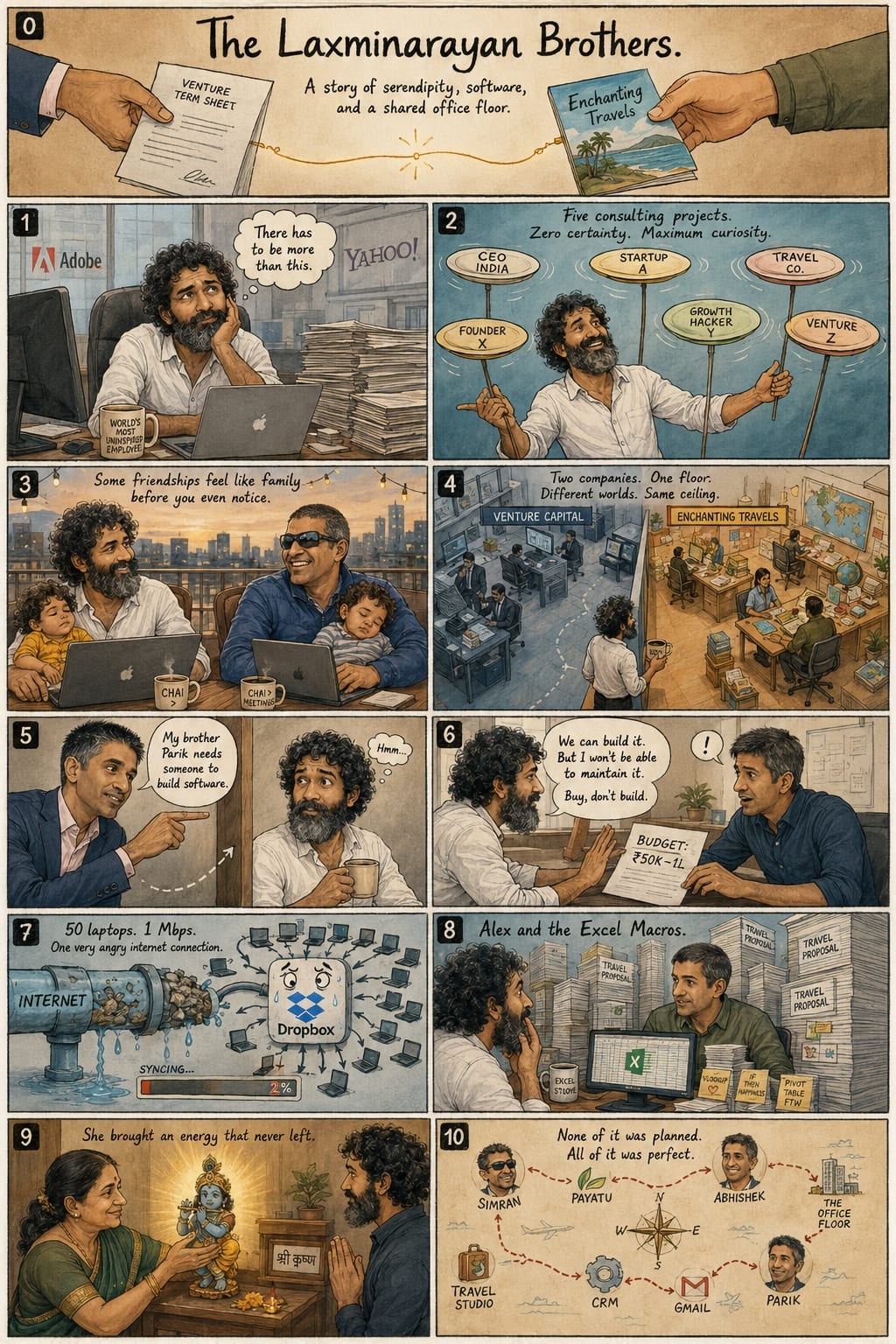
There is a kind of story that doesn't fit neatly into a resume. It doesn't have a clean beginning, a deliberate inflection point, or a hero who knew exactly what they were doing. It is the story of a sequence of coincidences — each one small and unremarkable on its own — that only reveals its meaning in hindsight.
This is one of those stories.
The brothers — who they are
When I say the Laxminarayan brothers, I mean two people: Abhishek Laxminarayan and Parikshit Laxminarayan — Parik, as the world knows him. Parik is the CEO of Enchanting Travels, now part of Travelopia. What the world knows is that he and I worked together — that I was CTO and he was CEO, and that we built something together.
That is only half the story.
Phase two — the curious consultant
To understand how I met them, I need to go back a step.
My career had three phases. The first was as an engineer — working alone, head down, deep in the craft. The third was Travelopia, a large corporate with all its complexity. But the middle phase — Phase Two — was the most formative. I was around 30. I was consulting. And I was, quite deliberately, trying to figure out who I was.
I didn't enjoy sitting behind a desk. I couldn't articulate it then, but I knew something intuitively: I could solve technical problems, but I needed a partner with excellent business skills alongside me for the work to feel alive. A technologist alone in a room — that didn't excite me. A technologist beside a business leader solving something real? That made my heart go.
So I went looking. I picked up five, six, seven consulting projects simultaneously — not out of greed, but out of genuine curiosity. I was meeting CEOs, understanding their problems, offering what I could. I was exploring the market the way you might explore a forest: no fixed destination, but alert to everything.
Simran, and the chain that followed
It was through this exploration that I met Simran — another technologist, security-oriented, and someone I connected with at a brotherhood level. We worked together on projects. We became family friends. I remember his twins waking me up when I was asleep. They felt like a glimpse of what family could mean, and those are fond memories I still carry.
Through Simran, I got connected to the Payatu team — the Null Conference crowd in Bangalore. And through those circles, someone mentioned Simran's classmate's husband. That person was Abhishek Laxminarayan.
Abhishek ran a venture capital firm. And here is the detail that mattered: his office and his brother Parik's office — Enchanting Travels — shared the same floor. One side of that floor was venture capital. The other side was a young travel company with a big dream.
I used to hang out on Abhishek's side. Talking to technologists, listening in, solving problems together. Good energy, curious people. One day, Abhishek said: "My brother Parik is looking for someone to build the software for his travel company."
The first conversation with Parik
I went and spoke to Parik. He mentioned a budget — maybe 50k, maybe 100k. Could we build something?
My answer surprised him, I think. I said: "Yes, we can build. But I don't think I can maintain it."
This wasn't me being clever. It came from something I had already learned about software: building is the easy part. Deploying, managing, maintaining, evolving — that is where most projects quietly die. My recommendation was honest: unless there was more budget and a longer commitment, buying standard software was the better path.
What I didn't know yet was what I was about to discover about Parik and his co-founder Alex Metzler: that they had been dreaming of a tech-native company from the very beginning. When I first met Alex, he had built extraordinarily complex Excel macros that could generate full travel proposals. I was genuinely impressed. That was my first encounter with American big-picture thinking — Parik — and German analytical depth — Alex.
Three projects, three lessons
I didn't become CTO in a single leap. I arrived through three projects, each one teaching me something I hadn't known I needed to learn.
i The Gmail migration.
Simran had started it. The problem was deceptively simple: Enchanting Travels had too many laptops syncing to Dropbox on a 1 Mbps connection. The internet was choking. Simran's elegant solution was to move the whole company to Gmail — then quite young as a platform. When Simran couldn't complete the project, he called me. I stepped in and finished it.
What I learned: the real challenge was never technical. Moving a global team — Parik between India, the US and South America; Alex in Germany; Florian in Africa — from one system to another is a human problem, not a technology problem. Change management, I was beginning to understand, was the actual skill.
ii The CRM.
A browser-based CRM system, nothing complicated, but well-received. What I learned here was how to organise data, how to align people around a common process, and how to deliver an outcome — not just a product.
iii Stabilising Travel Studio.
By this point, Parik and Alex had done their research and found Open Destination — a platform company whose product, Travel Studio, was being used by companies across the UK and beyond. They had made the right call: buy, don't build. My job was to make it work. We migrated it to the cloud. I worked with freelancers — Jyotish, Masroor — and the early AWS community I had been part of in Bangalore.
What I learned: I was beginning to understand, at a structural level, what kind of company Enchanting Travels was. It belonged to a category I would come to call tech-enabled businesses — not tech-native, but utterly dependent on technology to scale. And the defining challenge of such companies is not the technology. It is helping domain experts — specialists who are extraordinary at what they do — adopt new ways of working. I wished, back then, that I had studied psychology before computers.
What Parik is
I have thought, over the years, about how to describe Parik Laxminarayan. The clearest comparison I have found is the Oberoi — India's seven-star hospitality brand, known for a quality of service that is not performed but embodied. There is an attentiveness in everything Parik does. An openness to listening. A willingness to be challenged, and to challenge in return.
He is one of those people who epitomises a standard — not because he performs it, but because he cannot do otherwise.
The Krishna on the fourth floor
When we built the technology office — on the fourth floor, above Enchanting Travels on the second — Parik's mother came up one day and gave us a Krishna.
I believe that Krishna is still there. I believe it is the energy people feel when they visit that Bangalore office. Many people have told me, over the years, that there is something special about that space — a warmth, a connection they cannot quite name.
I owe that to her gesture. And to whatever higher energy she was invoking when she brought it.
What serendipity looks like in hindsight
A sequence of coincidences. A sequence of serendipity. Random meetings, trust in the universal unlocking of possibility, staying curious, staying humble, always listening to what the universe has to tell you.
None of it was planned. Simran introduced me to Abhishek's world. Abhishek pointed me toward his brother. Parik and Alex had a Dropbox problem. A migration became a relationship. Three projects became a decade.
I am grateful to the Laxminarayan brothers for what they made possible. And I am grateful to whatever higher intelligence arranged the sequence.