
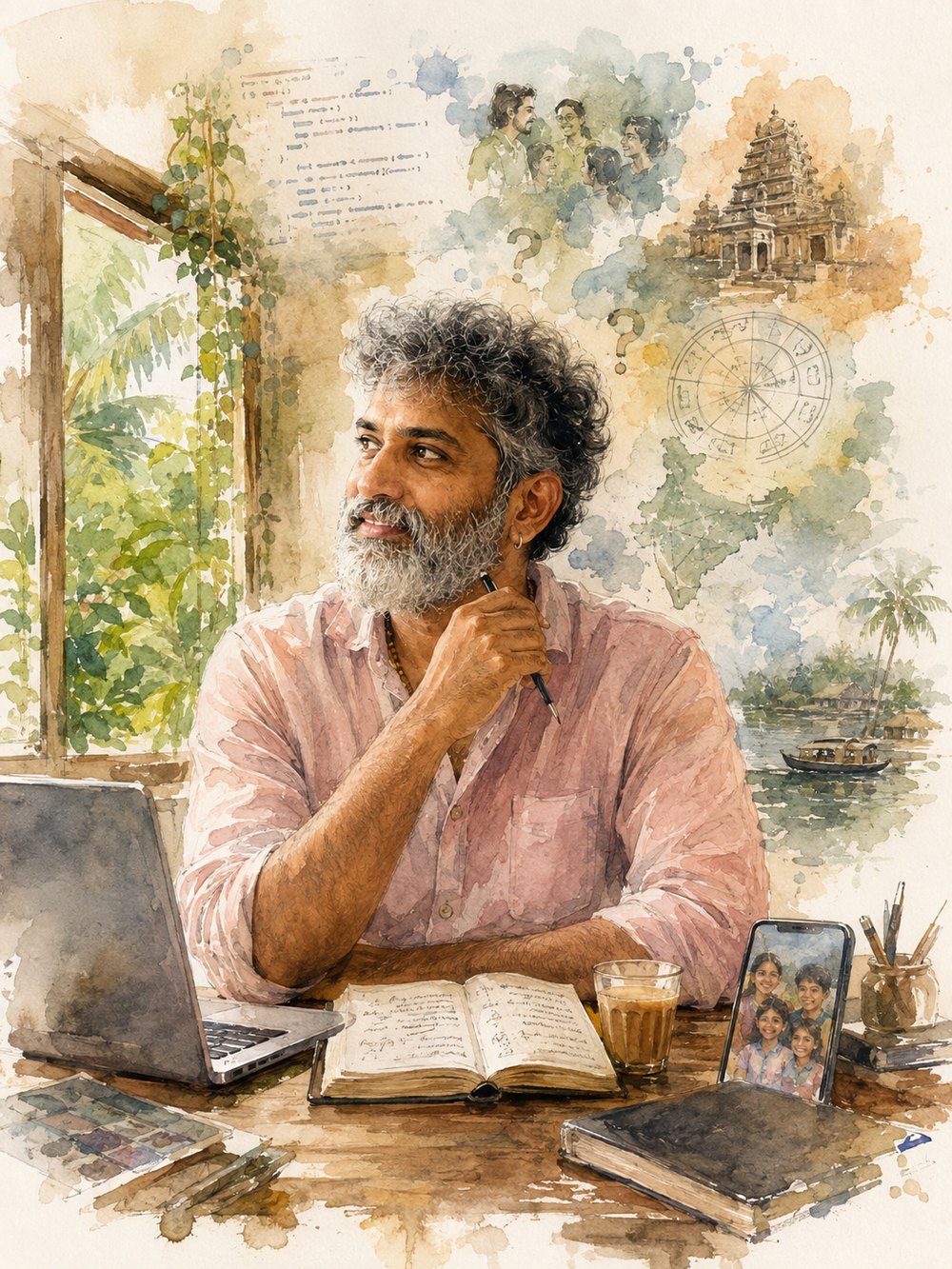
Engineer, observer, storyteller
Mid-forties, though you would not immediately place him. Greying. Cotton shirt, sleeves rolled without ceremony. Sandals rather than shoes. A laptop nearby and frequently forgotten, because a conversation became more interesting.
Give him a broken system and he asks why was it designed this way? Give him AI and he starts playing with it immediately. Give him a person and he asks what happened to make them who they are? Give him an ordinary morning — his mother laying out a pookalam before anyone else is awake — and there is suddenly a story hiding inside it.
He is never fifty–fifty. Where the marker sits is who he is.
A personality is not a list of traits; it is a set of pulls that never resolve.
He loves the technology, but it is not what he is interested in. He is interested in what it does to people.
He likes making things — products, experiments, websites, systems — but there is a strong let us see where this road goes in him too.
Dead centre, and the rarest thing about him. AI, software and organisations coexist comfortably with Amma, Kerala, family, Jyotiṣa, Auroville and Indic ways of seeing.
There is experience here, but nothing is delivered from a podium. It is closer to: “I noticed something. Come look at this.”
He will contemplate identity and humanity, and five minutes later turn a friend into a ridiculous cartoon. Mistype a URL on this site and it offers you a game.
He writes publicly, but the interesting material was never content. It is memory, relationships, observations — things he does not want to lose.
Before anything ships here, one question: would he do this?
He would
- Name the actual person — Rani, Amma, Venky, the in-laws
- Show his working, including where it might be wrong
- Credit the source louder than himself
- Keep the Indian word and gloss it, rather than reach for the nearest English one
- Let the reader win sometimes
- Leave a sentence unfinished when it is about hope
- Say plainly how the thing was made
He never would
- Shout, pop up, or chase you as you leave
- Lecture — or end on a conclusion where a question would do
- Publish someone else’s photograph as if it were his
- Use a stock image of a person
- Say “leverage”, “unlock”, “thought leader”
- Pretend he made it alone
- Let a page be tidy at the cost of being true
One is a guide. The other walks beside you.
One is a guide; the other is a notebook that somehow became a person. Which is why this site will never reorganise itself into a services page, and why every attempt to make it “clearer” would make it worse.
The defining characteristic, if I had to name one: insatiably curious, but increasingly interested in meaning rather than answers.
See also — how these pages get built · what he is doing now · everything, shelved