Go slow to go fast.
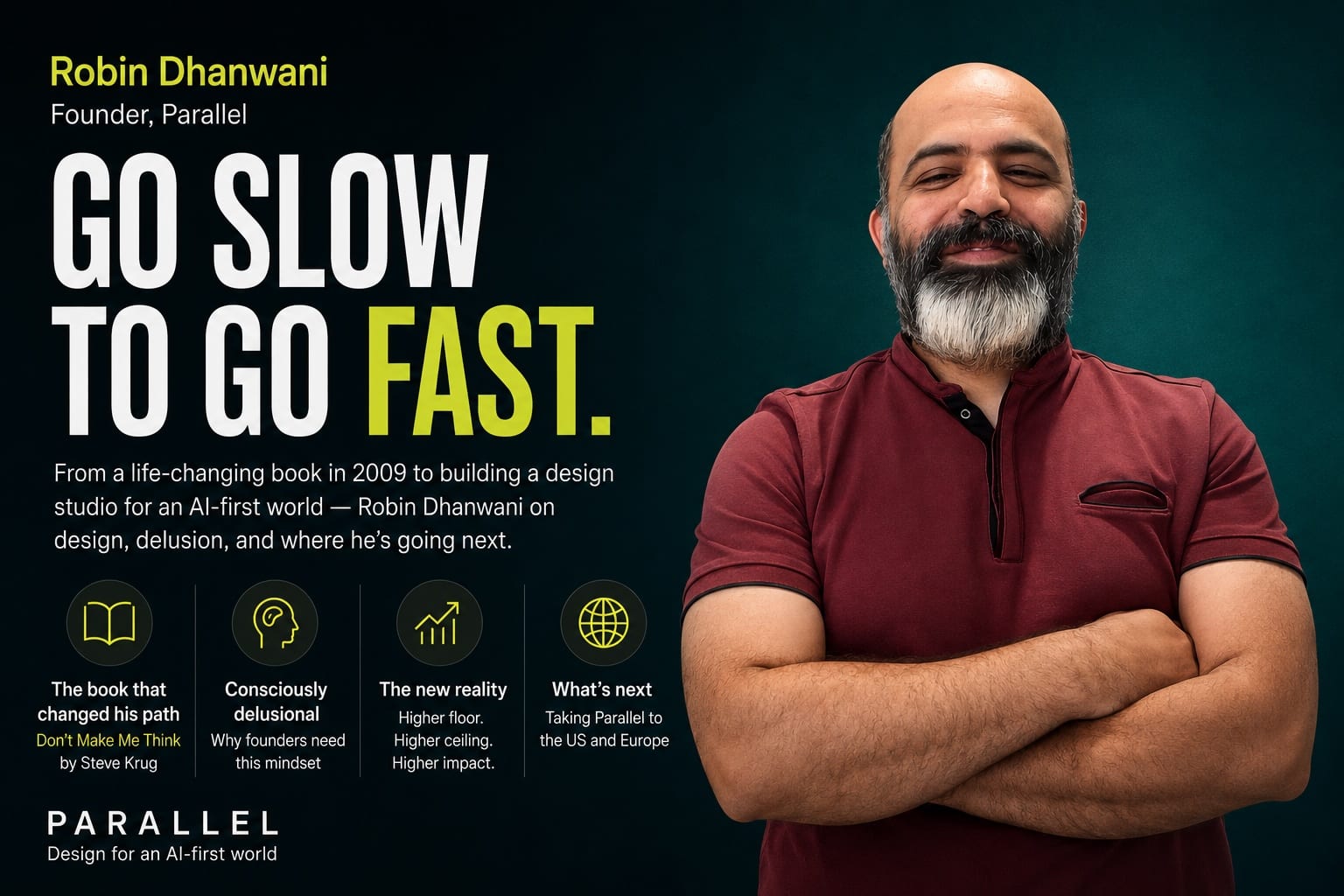
Robin Dhanwani grew up average. A book changed that. Now he runs a design studio expanding into the Valley and Europe — and he has a very clear view on why AI is the best thing that ever happened to great designers.
Robin and I go back a decade. I went to six design studios when I was trying to figure out what Artemis was — an IP we were building at Enchanting Travels. Six studios. None of them resonated. Then I found Robin. Engineer turned designer. That combination is rarer than it sounds, and it's everything when you're trying to build something that doesn't exist yet.
What I didn't know — and what this conversation unpacks — is that Robin almost didn't get there at all. He was an average student in a small city in Bangladesh, good at computers but indifferent about most everything else. He stumbled into a 2009 internship with someone "toying with some ideas" about restaurant software. His host handed him a book: Don't Make Me Think by Steve Krug. By the time Robin finished it, he knew what he wanted to do with his life. A single book, in the right hands, at the right moment.
The philosophy he's built around that moment — what he calls being "consciously delusional" — is the most useful framing of founder optimism I've encountered. Not naive. Not reckless. One notch above hyper-optimism, where you've crossed the line into believing something so fully that the world has no choice but to rearrange itself around you. He's been doing it for twelve years with Parallel. Now he's doing it again, quietly and deliberately, in the Valley and in Europe.
The AI question I put to him was the one I've been sitting with myself: if I can now build a functional website, a product prototype, a version-one of something — without a designer, without a developer — where does a design studio fit? His answer was sharper than I expected. The floor has risen. The ceiling is now sky-high. The companies that used to come to Parallel and say "help us build an MVP" are now coming with a different ask: "help us build a 10X product." The vibe-coders can ship a version-one. What they can't do is bring senior judgment, taste, the ability to cut through the team dynamics of a complex organisation and say: this is the right thing to build, and here is why. That's what the top 20% of designers can do, and that has never been more valuable.
He ended with something I'm holding onto: go slow to go fast. Build your foundations before chasing the next tool, the next shortcut, the next salary bump. Spend your first two years working with the best people you can find, learning like a doctor in fellowship or a lawyer doing articles. And read. Most of us in India don't read nearly enough. If you want to be great at anything in this era, that's where it starts.
— SREE
Chapters
- 00:00Intro
- 01:30Monday morning: puja over design sprint
- 01:50Robin's intensity — consistency across work, family, and life
- 03:35Growing up average — and why the right school mattered
- 05:36Computer science in Pune: "I didn't sign up for this"
- 06:22The internship that changed everything — Don't Make Me Think
- 09:36Early career: QA, a random trip to Goa, CodePaddle
- 11:3212 years building Parallel — the never-give-up story
- 12:21Being "consciously delusional"
- 13:20Parallel's elevator pitch: products that thrive in an AI-first world
- 13:48If AI can vibe-code an MVP, is design still relevant?
- 15:49Why the top 20% of designers have never been more valuable
- 17:16The 10X product — what clients actually need from specialists now
- 18:23The next delusional chapter: expanding to the US and Europe
- 20:31Life as an experiment, not a personal failure
- 21:04Advice for anyone starting or shifting into design right now
- 23:43Flow as a founder — not getting enough of it
- 25:02Closing thoughts
Parallel · Design for an AI-first world
Robin Dhanwani is the founder of Parallel, a design studio that helps companies build products that can thrive and succeed in an AI-first world. An engineer who pivoted to design after a single book changed his mind, he has spent twelve years building Parallel into a studio known for bringing both engineering rigour and design imagination to the table.
Parallel is now expanding into the US and European markets, working with companies that need senior design judgment — not just an MVP, but a 10X product.
parallelhq.com →