
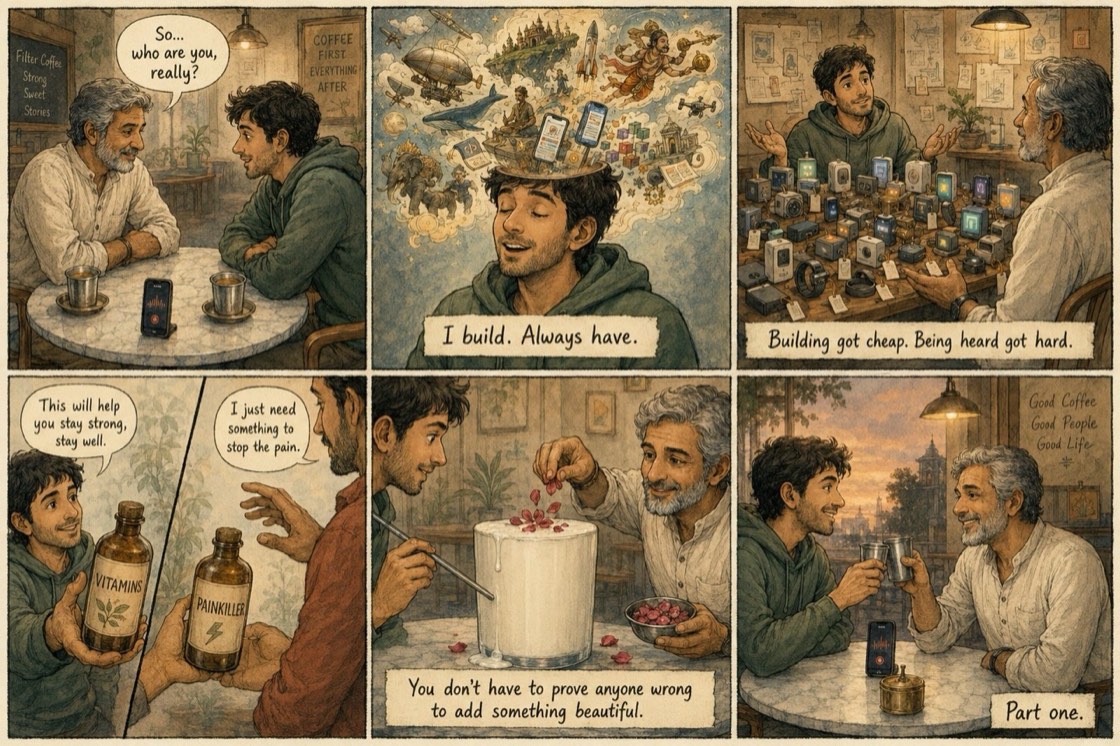
This is the first of a series I want to keep. Every so often I sit down with someone and record an unhurried, deliberate conversation — and then strip the names out, so what's left is the thinking, not the people.
The person here is a young builder — a dear friend's son. He comes from a generation that builds differently than the one I was trained in. I come from the corporate world, where you think idea-first, business-first, security-first, customer-first. He comes from a world where you just make the thing, and worry about the rest later. I wanted to understand that mind. So we sat down, switched on a recording, and talked for ninety minutes.
What follows is edited for readability and deliberately anonymised — names, companies, schools, products, the specifics that would identify him, all softened or removed. The detours are gone; the proper nouns are gone; the thinking is his. I've kept my own questions roughly as I asked them, because the friction is the point.
IThe intention
Whenever I speak to you, I get a builder's energy. You love to invent, to create, to make things. I come from a different world — corporate. There, we think the idea first, getting the business aligned first, security, the customer. There are two kinds of thinking. One is blue-sky thinking, without a constraint. The other is clouded-sky thinking — the sky isn't clear, because there are constraints everywhere.
I've wanted to invite you into my world many times. But honestly, I have no idea how to integrate you. Your world is different. Your needs are different. So this conversation is me trying to understand you. You were born into a different generation. What inspires you? Who are you? What do you actually want to do?
You couldn't have said it better. I think I am an inventor. I'm a builder. I love to create — I'm one of the most creative people I can think of. If I watch a film, read a story, a sci-fi book, a bit of mythology, the first thing my mind does is start picturing the world.
I have a personal project — a world-building thing, using AI. Pure passion, no business intent at all. The idea is simple: build these fantasy and mythological worlds, and try to teach an AI to be as creative as a human mind. My head runs on crazy stories — I'll be out running and a whole noir version of an old myth assembles itself. After AI arrived, I could finally pour what's in my head onto the page. It may not be perfect, but at least the mind has somewhere to land.
On the professional side — I studied in the US, a quantitative degree, then spent about six years in corporate: a large retailer's analytics team, then a global bank. But the creativity was always running on the side. I built a small data-protection idea — a way of scrambling text so it reads as gibberish unless you have the key — and patented it. I just didn't know how to take it to market.
I tried an AI interior-staging idea — upload a photo of an empty room, it furnishes it — but the space was saturated, so I dropped it. I built a keyboard-level writing assistant that refines your message right at the point you type it, and filed for that too. Then someone asked my father whether we were doing anything in data-loss-prevention for AI, and that pulled me straight back to the scrambling idea. I revived it, built a website, ran pilots, collected testimonials.
And I realised something about it. It's like a phone cover — it only really works wrapped around an existing infrastructure. As a standalone company, building all that infrastructure would take enormous time and money. So the smart move is to take it into a company that already has the infrastructure, and run it as a layer on top.
IIThe build is the easy part
I was listening to understand how creative you are — and it's genuinely hard for me to contain you in one role, one job spec. But here's my honest puzzle. I work with three kinds of company. A UK consultancy, where the problem is defined by the customer. A two-hundred-person innovation team inside the travel business I lead — analysts, product owners, engineers, all delivering an outcome with the business. And a SaaS signing product.
In all of them, building is maybe ten per cent of the problem. With AI, building got cheap and easy. The hard art is commercialising it — selling it, finding it a home. I believe this deeply: when the build gets cheaper, selling gets even harder. I call it the distribution problem. I've personally built thirty, forty things — and I have no idea how to sell most of them.
I completely agree — and it's the exact inverse of something Steve Jobs once said. He said the reason the sale is simple is because the tech is hard. To make a computer a ten-year-old can use, you have to solve everything the ten-year-old should never have to think about.
So with the signing product — there the build is small, and the entry is really sales and distribution, not innovation. That's something I'd be excited to learn, but it isn't my forte. I'm a build-innovate-create person. To put it simply: if you're the CEO, I think like the CTO.
IIIVitamins and painkillers
You met a design-founder in my network a while ago. What happened there?
A lovely person — but we think differently. He's a great problem-solver for painkillers. I think I'm a great problem-solver for vitamins. A painkiller asks, "what hurts badly enough that you'll pay me to make it stop?" A vitamin says, "this will make you better." Most of the founders I meet here want painkillers. That's where he and I didn't quite see eye to eye.
Think about where we're sitting — a coffee place that somebody built. The founder isn't asking us to reinvent it. He built the infrastructure; now he's busy running it, and what he wants are add-ons. If I bring you anywhere — travel, consulting, a friend's company — none of them will see your full intellectual range. They'll see a customer with good ideas and say, "great, come help me with operations, or the next kitchen." Nobody looks at raw potential and just hands you a canvas.
So you have to grow your way up. That's how the world works. And if you don't want to climb the ladder, then you build your own startup and prove the world wrong. But those are the two roads.
I hear you — but mine is a little different. I'm not walking up to the founder asking him to look at me and solve my problems. I already have something built. I'm asking: can I use your coffee shop — your resources, your infrastructure — as a base to take my thing further? And in that process, I'm building for you too. I'm adding a layer, not asking you to start over.
IVToo soon to judge
What you're describing sounds like a founder's office — a CEO who wants someone exploring special projects, pushing the business to think radically.
I interviewed for exactly that. But it turned out to be chief-of-staff work — billing, HR, tickets, routing problems between teams. Maybe that person just didn't have a clear definition of the role. But that was my experience of it.
Watch what just happened. You did one founder's-office interview, and concluded the entire category is like that. You're a son to your father — is every son in the world the same? You pray — do you pray exactly the way I pray? There are differences in humans. So why generalise from a single data point?
I'm sensing impatience, and judging too soon. Research is one data point — it's intellectual. To make it real, you have to interact with humans, maybe actually work in one place. Otherwise you're theoretically very strong and practically very weak. I'll repeat it, because I felt it strongly today: too soon to judge.
VAmerican energy, Indian body
You said you want to make money now. So what are you willing to compromise? The world keeps behaving in certain ways. If you want bleeding-edge, fast, polished tech, that lives in the US — it doesn't really exist anywhere else. Here, you have scrappy, hustle-ready startups — messy, founder-energy, come-what-may. Polish, or scrappy-but-a-builder. I don't know a third road.
The money is personal. Recently married, a family to look after, a house, the bills — and wanting to be a self-made man. You're right about the US; I'm locked in India for about three years for personal reasons, and after that I'm open to going back, or travelling back and forth. On the number — I was earning six figures in the US with six years of experience. Adjusting for cost of living and a two-year gap, I'm looking at something in the mid-tens of lakhs, and I'd come down a bit for the next three years.
A good business analyst who can also build is in roughly that bracket today. But here's the real point. If you've cracked the tech, what you still need to crack is working with humans. When I recruit, I don't recruit people to the company — I recruit them to a team. The first question isn't company-fit. It's: would you vibe with the people you'd sit beside every day?
And I'll name what I keep feeling. It's American energy in an Indian body. India is conservative by default; American consumer culture rewards crazy ideas with capital. You're bringing American energy and asking India to respond to it in kind. It won't match cleanly — not yet.
VIThe milk, and the rose petals
Let me give you something to sit with. There's an old story. When travellers came from Persia to India, a king sent out to meet them a glass filled to the very brim with milk — meaning: we are full. We have nothing to receive from you. The Persians sent the glass back — without spilling a drop — with rose petals floating on top. Meaning: we haven't come to fill your milk. We know you're already full. We've come to add petals. To beautify. To add value without spilling anything.
So — are you coming to me with a glass full of milk? Or are you coming to add the rose petals?
I'm coming with a straw — to help people drink the milk. Something new, to help you drink what you already have.
But look at the assumption hidden inside that — that I have a problem drinking my own milk. When you walk up to a business leader and say, "I have a better idea," however kindly you mean it, what they hear is: "you have a bad idea." That is not your intention. But it is how the world receives it. Watch it.
I'd push back gently there. I'm not saying your milk is bad. Think of the Japanese toymaker who couldn't sell a build-it-yourself toy — for the longest time, nobody wanted it. So they made a television show around it. Suddenly every child wanted to be that character, dress like him, build that toy. They didn't touch the toy at all. They created the need for it. That's what I want to do — add a layer that generates the craving, not break what you already have.
That's completely clear when you say it like that. But notice how much translation it took to get there. That distance — between what you mean and how it first lands — that's the thing to work on.
VIILife in years, not days
We should do a part two in six months, to see what's changed. I wanted to document this deliberately — in a casual conversation, we'd both forget what we said. And here's the thing I most want you to take away: start seeing life in years, not in days and minutes.
When I joined the travel business, it was a dull, boring place. Today our investors name us one of the most innovative AI companies in their entire portfolio. That took seven years. The exciting part comes after the hard work, not before it.
I completely understand that. I'm not walking in expecting only fun and excitement — there'll be roadblocks, and that's part and parcel of the work. The fun, for me, is the right people. And it's the intersection: what I love doing, what I'm genuinely good at, and what people will actually pay me for. If I can find that intersection, I'll be happy — and I'll earn well too.